OSHA's 2026 Focus on Engineered-Stone Silica Raises the Surveillance Bar
OSHA's 2026 enforcement emphasis under the crystalline-silica standards (1910.1053 and 1926.1153) centers on high-exposure trigger tasks, with particular attention to engineered stone containing more than 0.1% crystalline silica. Fabrication and finishing of those materials produce some of the highest airborne concentrations in the workplace, and the agency has made clear it is watching them.
For employers, the compliance backbone is medical surveillance: an exam offered at no cost, at a reasonable time and place, to every worker required to wear a respirator for 30 or more days a year, performed by a PLHCP and including spirometry and a B-reader chest X-ray. The baseline is due within 30 days of assignment unless a qualifying exam was done in the prior three years.
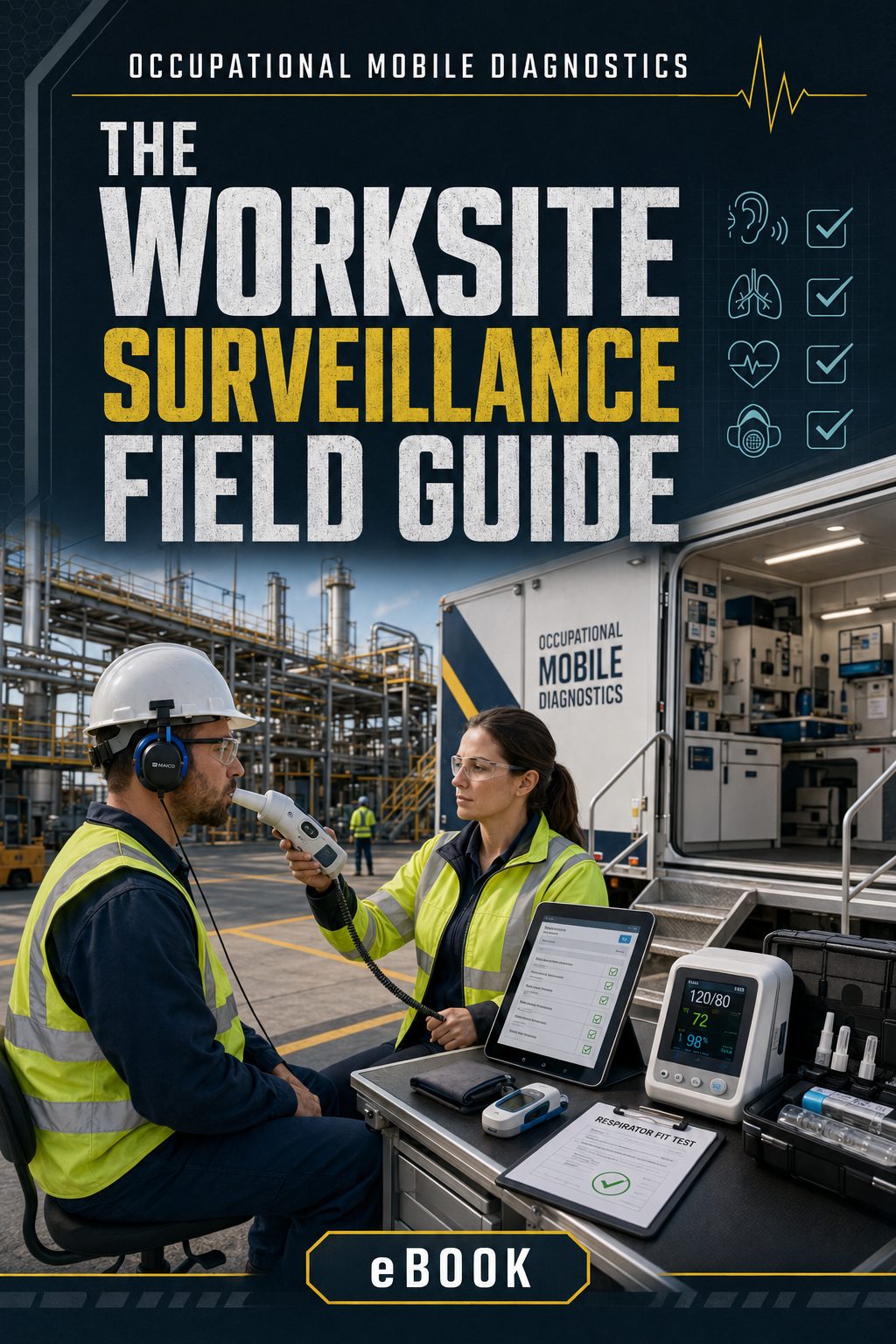
Meeting that duty across a distributed or shift-based workforce is where mobile screening earns its keep — the exam comes to the worksite, and the records come back audit-ready.
The X-ray cadence is where employers most often drift out of compliance without noticing. Under 29 CFR 1926.1153 the chest radiograph is a single posteroanterior projection at full inspiration, recorded on film of no less than 14 × 17 inches and no more than 16 × 17 inches or on a digital radiography system, and it is required at the initial examination and every three years thereafter — not annually, and not 'when we get around to it'. The baseline examination must be made available within 30 days of initial assignment unless the worker has had a qualifying examination within the previous three years.
Spirometry has its own specification, and it is unforgiving of shortcuts. The pulmonary function test must report forced vital capacity, forced expiratory volume in one second and the FEV1/FVC ratio, and it must be administered by a spirometry technician holding a current certificate from a NIOSH-approved course. Neither of these obligations is discharged by handing a worker a clinic address and hoping. Bringing the certified technician, the calibrated spirometer and the compliant radiography to the site is how a distributed workforce actually gets examined rather than merely scheduled.
Sources: OSHA — 1910.1053; OSHA — Medical Screening & Surveillance; OSHA 29 CFR 1926.1153; OSHA 1926.1153 App B